
The 2026 infrastructure trap: How modern tech companies hedge against hardware cost pressure
Summary
This expert review analyzes the impact of the 2026 global hardware shortage on the financial sustainability of tech companies. It examines how rising infrastructure costs are devaluing traditional software business models. The author explains why tech firms are moving away from full infrastructure ownership toward collaborative models to hedge technical risks and protect their profit margins.

Eugene Kalugin
CTO at Modsen
For most technology companies, owning infrastructure has always felt natural. Servers, cloud accounts, reserved capacity, and internal teams who “know the system” provided a sense of control. For a long time, this control was economically justified. In 2026, it is increasingly not. A tectonic shift in software economics has wiped out the old advantages of in-house teams.
Below is a strategic perspective on where that risk comes from, why owning infrastructure amplifies it, and how a more flexible model helps protect your business margins.
Not “just another expensive year”
Many teams still treat the current situation as a temporary price spike. They hope prices will stabilize or hardware will get cheaper. This assumption is risky. In 2026, we continue witnessing a structural shift called “AI-driven cannibalization” of the hardware supply chain.
4Q25–1Q26 DRAM & NAND flash price projections
4Q25 | 1Q26 | |
|---|---|---|
Total DRAM |
|
|
Total NAND Flash | +33~38% | +33~38% |
Source: TrendForce, Jan. 2026 |
Memory pricing is the earliest visible indicator of the infrastructure cost shift that began in 2025 and continues unabated into 2026
The data shows why owning infrastructure is now a direct margin risk. When components like DRAM and SSD spike by 60% in one quarter, your fixed-cost model becomes a liability.
I bet you've already known what happened. AI has permanently changed resource consumption:
Factories now prioritize HBM (high-speed memory) for AI chips, leaving standard server RAM in permanent shortage
Modern operating systems and cloud platforms reserve extra capacity for AI tasks by default, reducing the “usable” space you already paid for
Demand for infrastructure is growing faster than factories can produce silicon
This is a structural shift. For a software development company, every gigabyte of unoptimized code now costs significantly more than it did 24 months ago.
Why tech ownership concentrates infrastructure risk
When costs grow this fast, the most important question is: where does the risk settle? In practice, it accumulates at the point of ownership. For a company owning its infrastructure (or signs long-term, rigid cloud contracts), this locks in several risks:
Capacity lag: You buy resources based on assumptions made months ago, leaving you exposed to today’s price volatility
The “idle tax”: Unused capacity, once a safety buffer, is now “dead capital”
Operational gravity: Your best engineers stop building product value and start a defensive “war on infrastructure costs”
An inevitable collision now exists between old design patterns and the 2026 cost model. Fueled by the factors above, this process erodes your margins from the inside out.
How to approach AI generators as part of a system
Decision area | Capacity planning | What it means now |
|---|---|---|
Capacity planning | Safety buffer for future growth | Fixed overhead paid for months before it generates ROI |
Resource headroom | Ability to handle traffic spikes | “Dead capital” that carries a price premium |
Scaling strategy | Growing the business when needed | Each growth step makes the system permanently more expensive |
Engineering effort | Time spent building new features | Time spent keeping infrastructure costs under control |
Optimization | A “nice-to-have” later-stage task | Survival-level necessity to prevent runaway costs |
In 2026, infrastructure debt is the single greatest threat to a tech company’s unit economics.
Staff augmentation as an economic tool, not an HR task
If internal ownership internalizes the risk, how can a technology company change its operating model?
In 2026, keeping development 100% internal means you carry all the hardware price risk and architectural debt. But there is a way out. Staff augmentation.
Yes, I know what you’re thinking – the internet has been buzzing about this for ages as just another way to hire cheaper. But in today’s climate, it’s not about recruitment; it’s about financial hedging.
Staff augmentation relocates your exposure. It moves the burden of efficiency from an internal best effort – where your margins suffer if the code is heavy – to an external contractual requirement. High-performance architecture stops being just a goal and becomes a deliverable you hold your partner accountable for.
Now, every architectural choice is a TCO calculation. The strategic pivot for a CTO is moving away from the question “How do we build this?” to “Who carries the risk if hardware costs spike?” Transitioning to a specialized delivery model acts as a financial instrument to protect your margins from bleeding.
What to do next
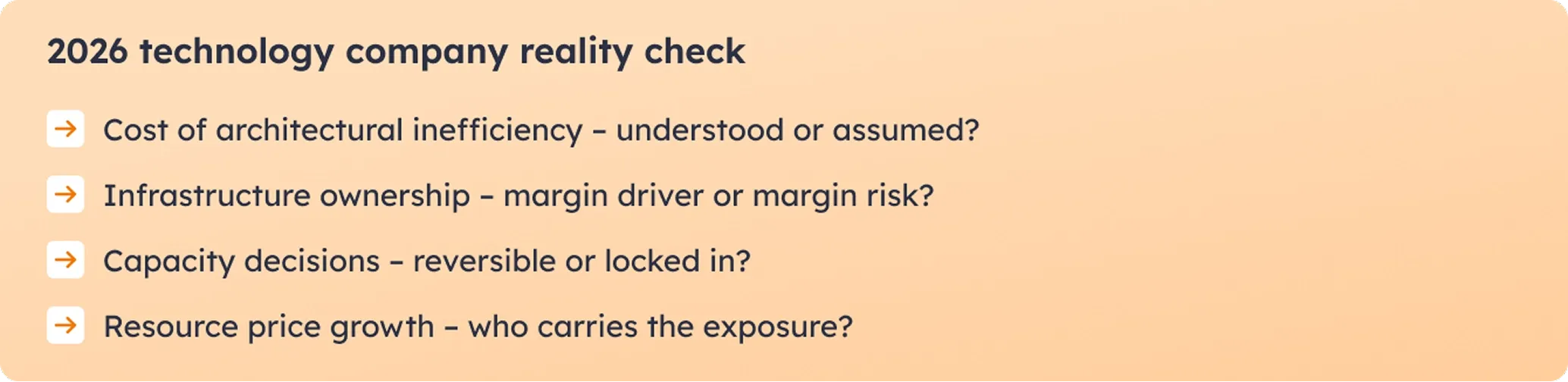
For tech leaders, these questions are now operational, not theoretical.
If you are responsible for engineering decisions in 2026, there is a practical checkpoint worth making.
Look at one concrete system:
A service that consumes noticeable memory
A component that scales unevenly
An area where infrastructure costs have grown faster than usage
Ask a simple question: who currently carries the risk of how this system consumes resources over time?
If that risk fully sits inside your organization, the cost behavior of the system is now your long-term commitment. At this point, it can be useful to involve an external team focused on efficiency and cost control – not to replace in-house expertise, but to validate architectural assumptions against real operating costs or to absorb a significant portion of the operational load and its associated financial risks.
This is the type of work we are typically brought in for. If you want to discuss similar architectural considerations in your context, we are open to a confidential, no-obligation conversation. The next step is simple – start the conversation here.

Get a weekly dose of first-hand tech insights delivered directly to your inbox